
10 Odoo Gold Partners for Inventory and Warehouse Management
Inventory is where an ERP earns its keep: accurate stock, fast picking, correct reordering and no surprises at quarter end. The ten Odoo Gold Partners below have worked on inventory, warehouse and distribution projects.
Brainvire and Control ERP lead the list, and eight more Gold-tier partners follow. Count each one on the same shelf: scanners, multi-warehouse transfers and the stock number your finance team trusts.
1. Brainvire
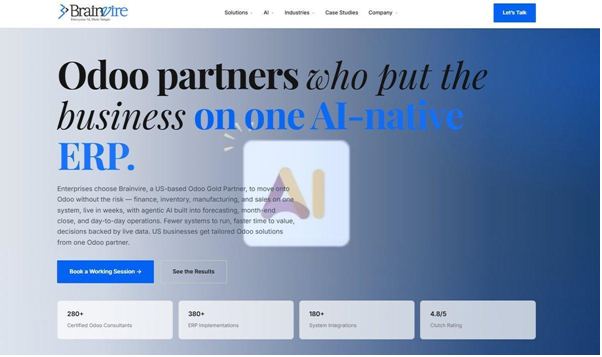
With a Texas headquarters, offices in Irving, Plano and Hicksville and hubs in Dubai, Mumbai and Singapore, Brainvire delivers Odoo as a Gold Partner in the USA, Canada, APAC and EMEA. Its consultants carry Odoo 19 certification.
Brainvire’s Odoo practice has completed 380+ implementations and 180+ integrations with 280+ certified consultants, and it holds a 4.8/5 rating on Clutch. It reached the Best Partner North America 2025 finals at Odoo, and it reports 95% retention across more than 2,000 brands.
Before any build starts, Brainvire runs discovery workshops that turn a loose ERP wish list into a costed, phased plan. Its flagship case covers 700+ sites in 12 countries on one Odoo 18 ERP and POS platform for a Fortune 500 fuel and energy retailer, and its Adobe, Shopify Plus, OpenAI, Microsoft, SAP, Salesforce and Databricks partnerships cover the surrounding stack. Inventory sits inside its POS and eCommerce practice, with Odoo stock tied to stores and online channels without a nightly export.
What Brainvire Delivers
- Implementation
- Migration and Upgrades
- Customization and App Development
- Odoo.sh Hosting and DevOps
- Third-Party and ERP Integration
- Support and AMS
- POS and eCommerce
- BI and Analytics
Industries: Retail, Store Solutions, Manufacturing, Jewelry, Automotive, Real Estate, Healthcare, Education, Logistics.
The team runs Odoo ERP implementation as a business program, not a software install, and keeps supporting it through consulting, managed hosting and application management.
2. Control ERP
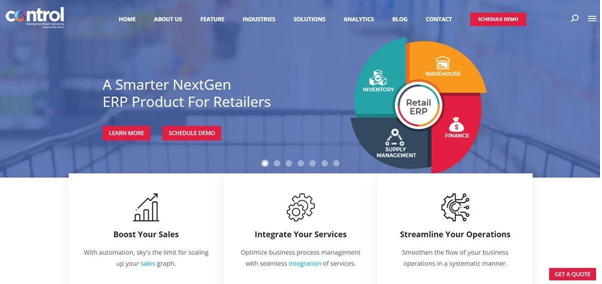
Control ERP, from Plano, Texas, takes a different route into Odoo: a ready-built platform for omnichannel retail that already joins sales, purchasing, accounting, inventory, production, POS, CRM, HR and payroll, and eCommerce. That shortens the path from contract to live trading.
Commerce is its strongest suit. Magento integration is native, the CRM is built for eCommerce, and marketplace connectivity is built in, which lets online and offline sales run side by side. Inventory is centralized across Odoo and Magento, so the web store and the shop floor see the same stock. A case study on its site covers a New York equipment supplier founded in 1949 that moved off an AS/400 system to Odoo, cutting manual workload by 42% across an inventory of more than 200,000 SKUs.
Platform Highlights
- Omnichannel retail ERP on Odoo
- Native Magento integration
- Built-in marketplace connectivity
- Centralized multi-channel inventory
- Integrated POS, CRM and accounting
- HR, payroll and reporting in one system
Best for: distributors and retailers that need one stock number across the web store and the warehouse.
3. VentorTech
VentorTech is an Odoo Gold Partner, a member of the Best Odoo Partners Alliance and a Zebra ISV partner. It works on integration-heavy Odoo projects for mid-size and enterprise companies, from warehouse and eCommerce to legacy migrations and finance management. As a Zebra ISV partner it ties Odoo to scanning hardware, and its United Tires case runs warehouse work through barcode scanners alongside Magento and carrier integrations.
Best for: warehouse-heavy businesses that need scanners and hardware connected to Odoo.
4. Sodexis
Sodexis, a Gold-tier Odoo partner, has spent more than a decade on wholesale and distribution projects.
Best for: wholesale and distribution companies with complex stock flows.
5. QOC Innovations
QOC Innovations works with manufacturers, distributors and growing businesses and cites more than 400 years of combined experience across manufacturing, inventory management, planning, warehousing, accounting and supply chain operations.
Best for: manufacturers and distributors with planning and warehouse complexity.
6. S4 Solutions
S4 Solutions, a Gold-tier Odoo partner, works with discrete manufacturers on ERP, MES, supply chain, warehouse and quality, and holds that the minimum process and technology should deliver the maximum value.
Best for: discrete manufacturers that need MES, warehouse and quality in one project.
7. Ksolves
Ksolves is a Noida-based Odoo Gold Partner, listed on India’s National Stock Exchange, with 100+ certified Odoo developers and an Odoo Best Partner India 2025 label. It markets an AI-first approach to implementation. A published case reports an auto parts distributor cutting stockouts by 40% through real-time inventory across multiple warehouses.
Best for: multi-warehouse distributors with high SKU counts.
8. Novobi
Novobi, from Austin, Texas, is an Odoo Gold Partner with 200+ implementations and 500,000+ hours of Odoo work by its own count. It is aimed at multichannel retail, wholesale and distribution businesses that want a quick, low-risk go-live.
Best for: mid-market sellers that want a fast go-live on proven workflows.
9. Octupus
Octupus is a Gold Partner near Madrid with offices in Spain, Cuba and India and roughly 20 developers. Its Odoo profile lists Ecommerce and Digital Marketing specializations, and its own Multichannel connector carries 250+ integrations covering Amazon, eBay, Temu, Shopify, Magento and carriers such as DHL and UPS.
Best for: sellers whose real project is marketplace and carrier sprawl rather than Odoo configuration.
10. Captivea
Captivea, an Odoo Gold Partner since 2014, works from Orlando, Florida and France, with additional teams such as Captivea Luxembourg. Its site lays out industry practices for retail, automotive and manufacturing. Its retail practice centers on inventory held centrally across warehouses and stores, tied to POS and eCommerce.
Best for: multi-site retailers that keep stock in several warehouses and stores.
Stock Check: Questions for Gold Partners on Inventory
Put these questions to every Odoo Gold Partner on your shortlist. Ask for:
- how barcode scanning and warehouse hardware connect to Odoo
- how multi-warehouse transfers and reordering rules are set up
- how bills of materials, work orders and planning are configured for your process
- how quality checks and traceability are handled
- who supports the system during operating hours
- references from distributors or manufacturers of your size
Warehouse projects succeed or fail on the floor, so ask to speak to a user at a reference site, not just the sponsor. Start with Brainvire for stock tied to POS and eCommerce and Control ERP for central Odoo and Magento inventory.
How Invisalign Aligners Interact With Existing Dental Restorations During Orthodontic Treatment
Understanding the Compatibility Between Clear Aligners and Dental Work
The journey towards a straighter smile through Invisalign Leeds has become increasingly popular across the United Kingdom, yet many individuals with existing dental restorations find themselves wondering whether their previous dental work will pose obstacles to treatment. The relationship between invisible orthodontic devices and restorations such as crowns, bridges, veneers, and implants is far more nuanced than one might initially assume, requiring careful consideration and professional assessment before embarking on treatment.
Modern orthodontic technology has advanced considerably, and practitioners who specialise in Invisalign treatments regularly work with patients who have various types of dental restorations in place. The fundamental principle underlying successful treatment lies in understanding how these restorations respond to the gentle, consistent pressure applied by clear aligners throughout the orthodontic process.
How Dental Crowns Respond to Clear Aligner Therapy
Dental crowns represent one of the most common restorations that patients bring to their orthodontic consultations. These tooth-shaped caps, which cover damaged or weakened teeth, generally interact well with clear aligners, though certain considerations must be addressed. The surface texture of crowns differs from natural tooth enamel, which can affect how attachments—small tooth-coloured bumps that help aligners grip teeth—adhere to the restoration.
The material composition of the crown plays a significant role in treatment planning. Porcelain and ceramic crowns typically provide sufficient surface area for aligner contact, whilst metal crowns may require alternative approaches. Understanding whether crowns, bridges, or veneers affect Invisalign eligibility helps patients set realistic expectations before beginning treatment.
The Science Behind Aligner Pressure and Restoration Stability
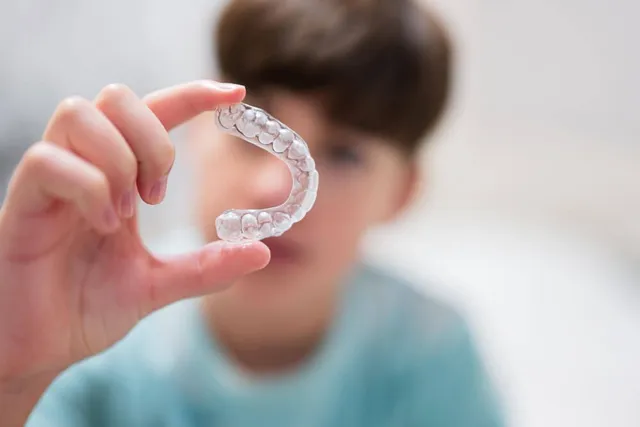
Clear aligners function by applying controlled forces to teeth, gradually shifting them into desired positions over time. When restorations are present, orthodontic specialists must consider whether these forces might compromise the integrity of the dental work. Fortunately, the gentle nature of aligner therapy typically poses minimal risk to well-executed restorations that have been properly bonded or cemented in place.
The key concern revolves around whether the restoration itself will move along with the natural tooth structure beneath it. In most cases, crowns that have been securely attached will move as a single unit with the underlying tooth, responding predictably to the orthodontic forces applied by the aligners.
Bridges and Fixed Prosthetics: Special Considerations
Dental bridges present unique challenges within clear aligner treatment due to their fixed nature connecting multiple teeth. Unlike individual crowns, bridges anchor several teeth together, which can limit the independent movement required for comprehensive orthodontic correction. The success of treatment depends largely on the location and span of the bridge, as well as the specific tooth movements needed to achieve the desired outcome.
In many instances, orthodontists can work around bridges by focusing tooth movement on the unrestored teeth whilst maintaining the bridge’s position. However, some complex cases may require bridge removal and replacement after orthodontic treatment concludes. Exploring treatment options when crowns are present provides valuable insight into how practitioners navigate these situations with careful planning and patient communication.
Veneers and Bonding Materials During Aligner Treatment
Porcelain veneers, those thin shells that enhance the appearance of front teeth, generally accommodate clear aligner therapy quite effectively. The smooth surface of veneers does, however, present challenges when orthodontists need to attach the small composite buttons that facilitate specific tooth movements. Alternative attachment positions or modified treatment approaches often provide satisfactory solutions.
Composite bonding materials used to repair chips or reshape teeth typically withstand the forces exerted by aligners without issue. The orthodontist may need to adjust or replace bonding after treatment to ensure the final aesthetic result aligns with the newly positioned teeth. Learning about Invisalign compatibility with various dental restorations empowers patients to make informed decisions about their orthodontic journey.
Dental Implants and Their Role in Treatment Planning
Dental implants occupy a distinct category within orthodontic planning because, unlike natural teeth, they lack the periodontal ligament that allows tooth movement. Implants remain fixed in position throughout aligner therapy, serving as stable anchor points around which other teeth can be repositioned. This characteristic can actually prove advantageous in certain treatment scenarios, providing predictable reference points for tooth alignment.
Achieving Optimal Results With Existing Restorations
The interaction between clear aligners and existing dental restorations ultimately depends on thorough assessment, strategic planning, and open communication between patient and practitioner. Modern orthodontic techniques accommodate a wide range of dental histories, allowing individuals with restorations to pursue straighter smiles with confidence. Professional evaluation remains essential to determine the most appropriate treatment approach for each unique situation, ensuring both orthodontic success and the longevity of existing dental work.